 CREATING
 USING AN ACTOR MAP
TO FIND SYSTEMIC BUFFERS
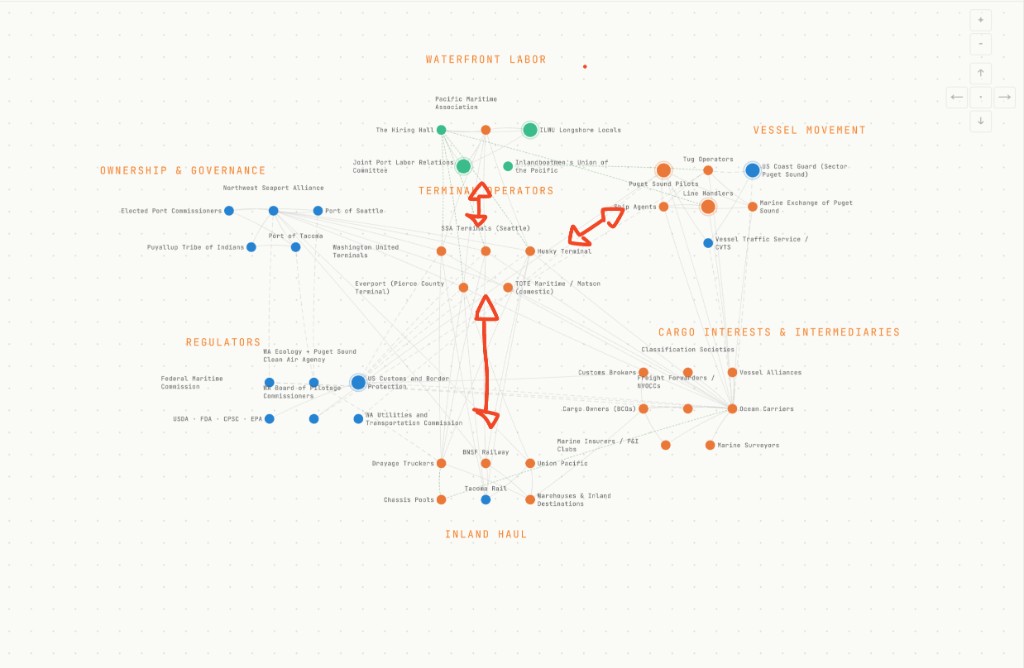
I recently built an actor map of the Seattle-Tacoma container gateway: the forty-some businesses, unions, and agencies that move a container, and who each of them answers to. This post is about one way to use it.
What are we doing?
Actor maps are great for those trying to understand the systemic character of any system, be it a port, a company, or any other ecology of relationships.
Once built, an actor map has perennial benefits, starting with the orientation the builder internalizes by making it and a topology you can use to locate systemic patterns.
Every system contains patterns that tend to emerge consistently among the relationships: stocks and flows, feedback loops, interfaces, orchestration layers, monitoring layers, reconciliation mechanisms, etc. Knowing where to look for the abstract allows you to find the concrete instance, and more importantly, understand the context in which it exists.
These patterns represent leverage points, which are points at which a system can be improved.
In this case, we are looking for buffers using the Seattle-Tacoma Gateway Actor Map.
Why buffers?
Buffers are important to the resilience and reliability of a system’s operation when faced with regular and unexpected variance. Finding them, improving them, or introducing them has high potential to improve the lives of the people within the system as well as improve the overall system itself.
The entire port ecosystem must absorb shocks and variability it does not control. Regular oscillations such as demand surges, regulatory change, and business cycles, as well as larger disruptions like political upheavals, natural disasters, and supply chain disruptions frequently cascade through a web of highly enmeshed relationships. If the system cannot absorb, dodge, or otherwise handle such variations and shocks, it will experience acute dysfunction, financial loss, and a deteriorating reputation.
Failure to handle variance is a clear economic reality, but it also represents a poignant lived experience: inadequate buffers cause stress, overworking, layoffs, and general human and organizational insecurity.
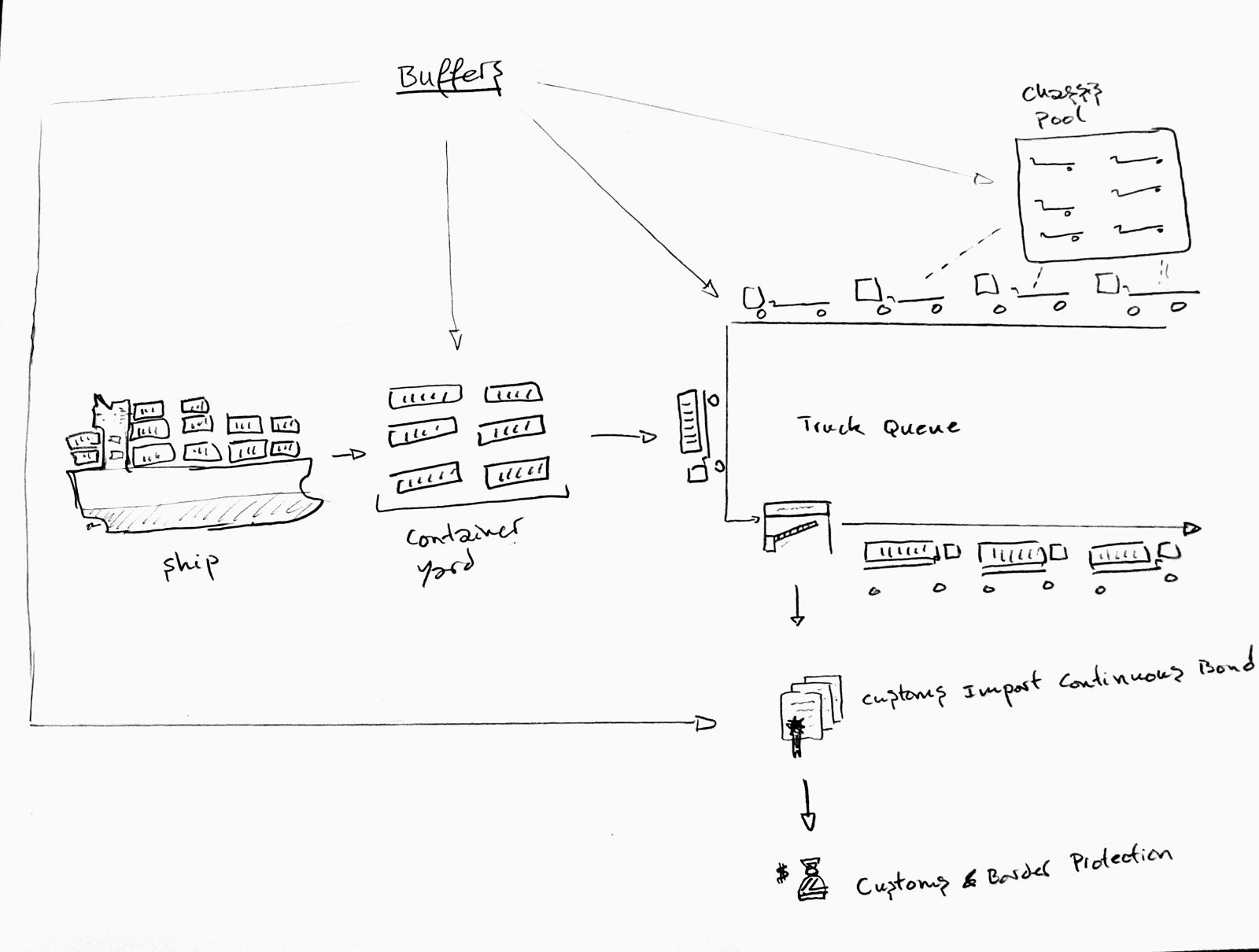
Buffers exist to handle these shocks. Some are obvious (e.g. container yards) and some are more nuanced (e.g. legal and financial instruments that protect the flow of goods from political and legal disruption).
Obviously, the ports have survived this long and faced global and regional disruptions throughout their early and recent history, so buffers are here somewhere. Our goal is to find them and make a few observations.
How to find them
First let’s lock down what we are looking for: A buffer is a systemic pattern that describes the capacity to accept varying levels of input or external conditions and sustain function and consistent output.
It has a classic incarnation: a bathtub with a single drain. The drain will issue water at the same rate even if you turn the water on and off, the faucet spits water out twice as fast as the drain drains (varying levels of input), or a bucket of water falls over into the tub (external conditions). The tub may overflow eventually, but while it can contain all inputs, the drain will remain consistent.
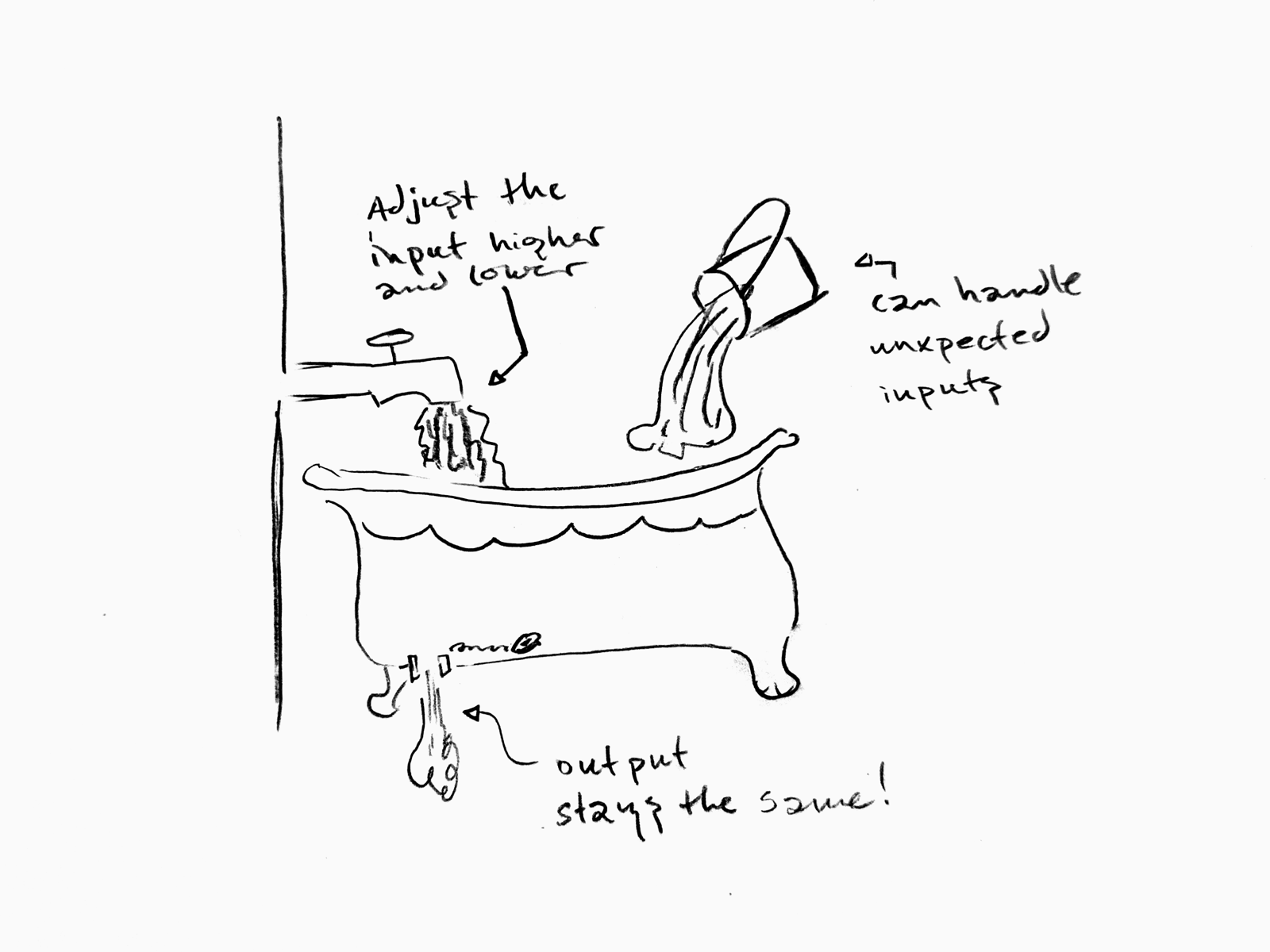
In the wild, they can be as simple as the bathtub or very abstract, but finding them remains fairly simple because they always achieve the same function, no matter how sophisticated they are. Also, they tend to emerge organically or by design at specific points in pretty much every system.
You can usually find them topologically:
- Wherever batching occurs (when something is processed into smaller somethings)
- Where physical movement changes modes or intersects with other movements within the system
- Where the system (or subsystem) receives an input or issues an output from another system
- At handoffs along the critical path
- Wherever there is “push” and “pull” within the system
- Anywhere a natural bottleneck forms (physical, regulatory, process, etc.), there are likely to be buffers
You can also look for behavioral indicators such as:
- Where actors are waiting or idle for long periods
- Places where actors must “scramble” acutely for a period, followed by long waits
- Places that break when something unexpected happens
- Hiring and firing cycles, high labor turnover
Once you start seeing them, you will see them everywhere.
What I found
I found many buffers using the actor map; here are a few of the interesting ones:
some are pretty straightforward…
- The tiering system of the hiring hall: regulates the supply and flow of registered workers based on demand and joint union-employer policy.
- The container yard + gate queue: a self-organizing queue of trucks that arrive to carry away a batch of containers from the container yard.
- Overflow mechanisms: such as night gates, and temporary off-dock yards.
- The chassis pool: a shared pool of physical chassis that acts as a flexible resource various actors rely on to satisfy variable demand.
…some are more subtle (or at least harder to see using the map):
- Puget Sound Pilots pooling their fees: this method isolates a ready supply of highly valuable and slow to replace expertise from demand volatility.
- The sound itself: when a ship cannot find a berth, it can anchor in safe, well-regulated water in the meantime.
- The financial mechanisms, for example a continuous import customs bond: uses the guarantee of a trusted surety to buffer the movement of physical goods from the complex, ever-shifting financial reconciliation. This is an import strategy general to American ports, but still plays an important role in our specific Seattle/Tacoma system.

Insights
In a system this large, there are a huge number of buffers and interesting things to understand. While we are just scratching the surface, here is what I found:
The container yard + truck queue
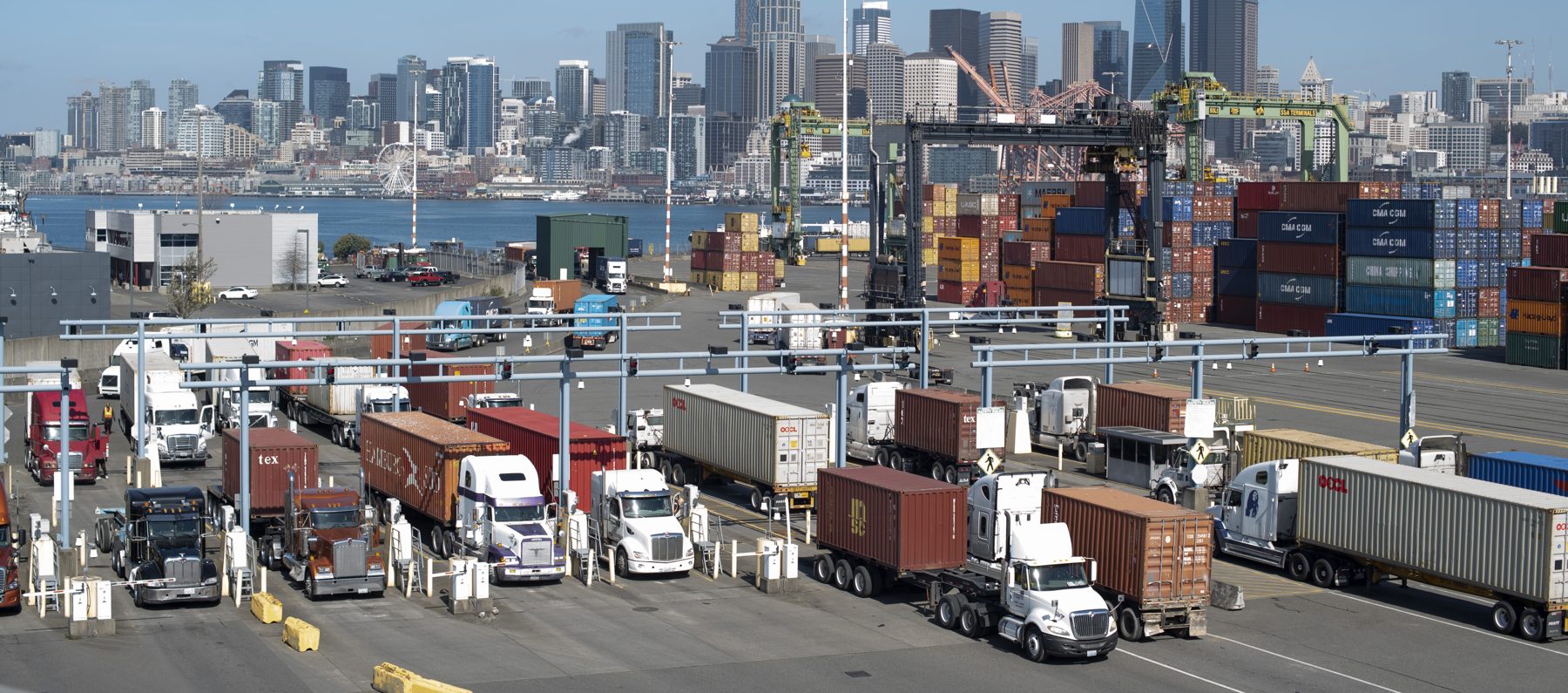
- There is an interesting financial layer to the trucking queue: truckers absorb a significant financial element of how well the yard buffer works. When the queue is crowded, the vast majority of truckers wait using unpaid time in long lines. Other ports, such as Vancouver and Los Angeles, use technology-enabled pricing to account for trucker congestion: Vancouver bills terminals for measured waiting and passes the fee to drivers, while Los Angeles charges cargo owners to fund extra off-peak gate hours. The strategies differ, but both make the cost of congestion perceivable to other actors and give them an incentive to reduce it, rather than forcing the sacrifice from truckers, who are relatively less powerful.
- There are mitigation strategies for when the yard and queue are overwhelmed, such as the night gate and temporary, off-dock yards. However, these are only spun up in times of acute crisis.
- There is a proposal to improve throughput at Terminal 18, the NWSA’s FY25 PIDP grant application. One specific mitigation is “weigh-in-motion scales”.
- There is data gathering infrastructure that can be used for various orchestration strategies, however, like many issues for buffers, who benefits from owning the problem is often a stopping force.
Continuous import customs bonds and cascading information layers
- There are abstract/financial/digital systems on top of the physical systems that often lag behind due to bureaucratic complexity and prioritization of physical movement (this is reflected in the circulation of fees of the trucking queue as well)
- Speeding up these abstract systems would likely reduce risk, however, some may remain constrained by the physical layer.
- The information layers that smooth operations by mitigating or sidestepping the need for buffers are highly dispersed, although counterpoints exist: the Marine Exchange and the emergency response tug at Neah Bay are examples of the ecosystem funding orchestration and reserve capacity for a clear common good.
- Of the dispersed systems, digital orchestration systems are especially dispersed. (...we care because digital orchestration is often a good replacement for expensive buffers)
- The trucking queue is well provisioned with eModal for the international terminals. It appears there is a rich capacity to the platform. However, whether it provides integration value is unknown.
- Ocean arrivals are not captured by a centralized digital system, such as they are in California.
- Chassis pools are visible, but I could find no way of informational integration that would allow automated provisioning or forecasting.
- Orchestration of rail transportation from the dock is not known to be integrated or visible to any other actor.
The chassis pool
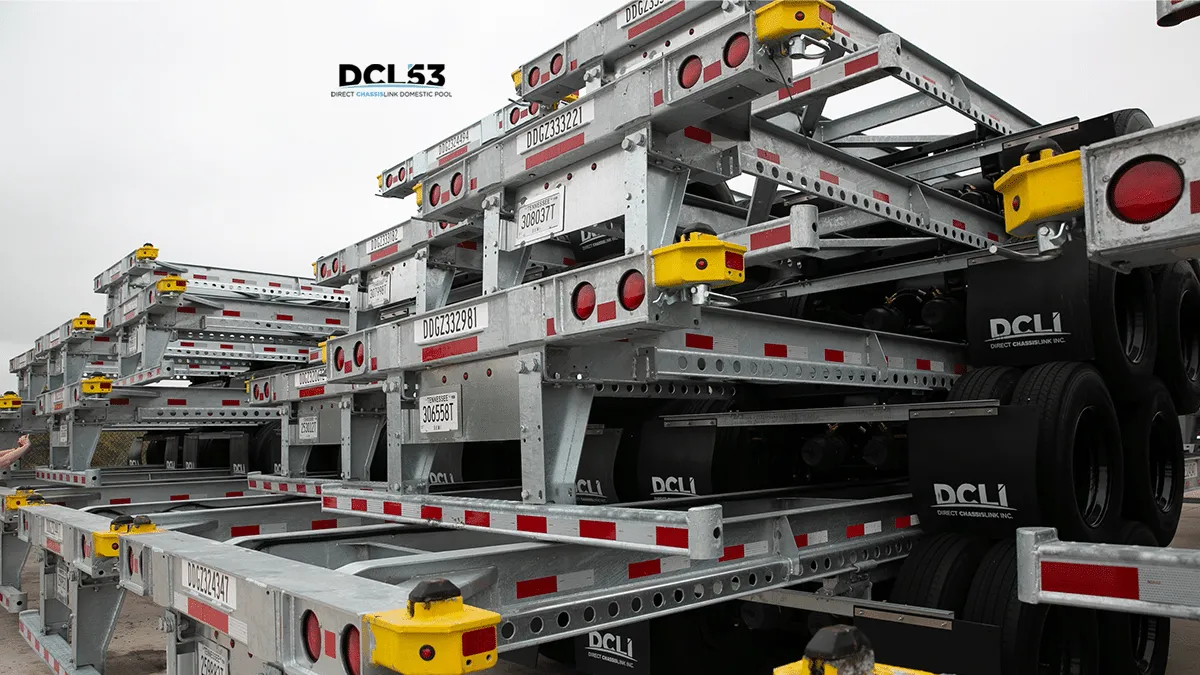
- The chassis pool has undergone an interesting transformation. Essentially, what once belonged monolithically to ocean carriers was shocked dramatically into its current form of a pooled service serving multiple carriers on demand.
- This transformation happened over the span of 2009 to the mid-2010s. Due to new regulation in 2009 (FMCSA’s Roadability rule) and the financial crisis of 2008, the incumbent system of carriers providing chassis for free was forced to transform into a new disparate set of firms that specialized in running “chassis as an on-demand service”. These firms subsequently merged their local fleets in 2015 to provide the necessary depth of pool and reduce administrative overhead.
- This is how buffers are most often created: through crisis and chaos. This is not a judgment or admonishment, as crisis is often the natural catalyst to evolve a system, but it is a great example of what the fallout looks like when a shock is too great for the buffers within a system to handle.
A couple ending notes when it comes to improving/dissolving buffers within a system
- A pro: Buffers are the type of pattern that when improved, typically cascade positively across to other local actors and benefit the overall system itself.
- A con: Often buffers fall into a category of problems where it is not worth anyone improving when things are normal, so it goes unowned until a crisis. During a crisis the responsibility of resolution falls to an authority who makes demands of whoever is most positioned to relieve the issue, after which status quo is reestablished and actors generally go back to doing the least for the most return. This is the reality of the system you must work with rather than try to fight or persuade against. FWIW, this is a combination of the Free-rider problem and the “Shift the burden” system archetype.
- Counterintuitively, perhaps the best way to “improve buffers” in a multi-stakeholder system is to dissolve them through improving orchestration and throughput as well as pricing in overload to standard transactions; and critically, doing so based on incremental benefit to an actor’s personal incentives (better, faster, cheaper). That said, appealing to a common good is not unprecedented.
Conclusion
So, we used the actor map to find buffers and make insights! We found a lot of interesting things and have acquainted ourselves with the deeper nature of the port system using a general process.
The next step would be to take these insights and consider what improvements can be made to help the systems grow stronger while making sure to keep the known pitfalls of creating buffers in mind.
Thanks for reading!
Are you involved in any of the elements described here? I would love to talk to you and publish any corrections you have.
Also, please reach out if you want to talk about the port system, have feedback for me, or simply want to talk with a fellow systems nerd.